
Originally published at: Watching the Podcast Bubble Burst From the Inside - TPM – Talking Points Memo
I started my first podcast in 2009. It wasn’t anything special, just a venue to practice documentary audio and force myself to publish something every two weeks. I was a kindergarten teacher in New York City, trying to figure out how to break into public radio. What I couldn’t have imagined then was that within…
2 Likes
Not a podcaster, just a consumer, but:
What about the pivot to video? It seems pretty clear to me that a lot of what used to be podcast content is now streaming video.
3 Likes
The podcast category I listen to most often, and regularly, are short fiction podcasts, particularly in science fiction/fantasy areas. These are mostly viewer supported, via Patreon and other ways of support, although several have begun to accept advertising as well. And all ask/beg for continuing subscriptions, support and donations.
I’ve been a regular listener to several for over a decade. CLARKESWORLD and LIGHTSPEED, among others, present audio versions as an adjunct to online print magazines. Escape Artists, Inc., is the umbrella org for a number of fiction podcasts; ESCAPE POD for SF, PODCASTLE for fantasy, PSEUDOPOD for horror, CAST OF WONDERS for young adult fiction, and CATSCAST for SF/F/H cat stories. DRABBLECAST does weird and bizarro. And numerous others, but I only have so much listening time.
3 Likes
If my husband is any indicator of the health and popularity of podcasting, it has some years left ahead. He’s a very devoted fan of A History of Rock & Roll in 500 Songs, … and Andrew Hickey is only. what, a quarter of the way through his history after something like 8 years??
Hang in there, passion project podcasters, we still love you!
8 Likes
… is fantastic!!!
I enjoy history podcasts. Many of those (History of Rome, History of England, History of Egypt, Our Fake History, just to name a few) are very small operations. Just one or two people, maybe a production helper. Yes, I support as many as possible on Patreon.
Indeed, lots of videos are essentially podcasts. Or they are videos of podcast, similar to video versions of radio shows. Or they provided enhanced content. Ha, ha, as old folks, watching videocasts is the highlight of our date nights. Max Miller, anyone?
There is still a place for audio content - driving, sleeping, housework.
6 Likes
Being retired I listen to podcasts every day in my car while doing.a crossword. History of music, Europe, cinema, broadway are my favorites. Politics and most sports I find unsatisfying. Peace!
2 Likes
Agree, i listen to podcasts when I am doing housework or yardwork. I have listened to a combination of political podcasts and ones that focus on history. Bad Women -The Ripper Retold was a well-done series about the victims of Jack the Ripper. The lives of the victims were forgotten in the frenzy to identify the Ripper. She humanizes them.
4 Likes
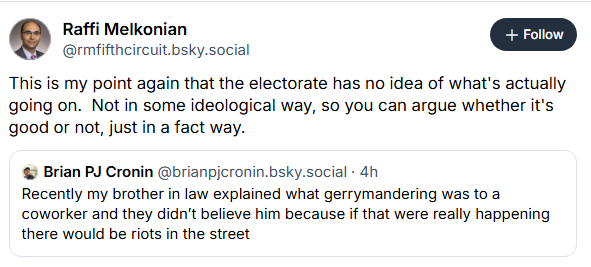
Ummm, a terrible secret about democracy is that almost half of the voters have below average intelligence.
Don’t tell anyone!
3 Likes
I started my first podcast in early 2011. For the previous couple of years I had joined a network of comedians and entertainers on Twitter. This was back in the day where Twitter operated almost as a real-time chat room filled with a lot of creative types. I was a nobody from the middle of nowhere, but suddenly I’m swapping jokes in real time with Garry Shandling. Yes folks, Twitter used to be that cool.
My only real experience in journalism or interviewing was from a decade earlier. I wrote for an e-zine (fancy name for a website ran like a freelance magazine) sending in music reviews in exchange for promotional CDs and some artist access. It was toward the end of a bubble, when record labels were still holding on to the idea of physical product sales as a revenue driver.
The first podcast coincided with the beginning of another not bubble but boom. Stand-up comedy had a huge boom in the 80s and early 90s and then had began to fizzle. A resurgence started in the mid-late 2000s. “WTF” with Marc Maron dropped in 2009, followed by the Showtime series “The Green Room with Paul Provenza.”
Think about it. In 2011, Twitter had 100 million users. It was a very interactive and accessible product. Artist to fan engagement was huge. Stand-up comedy was booming again. If you had any knowledge or fandom of comedy and any audience reach, you could have a pretty cool podcast. No money, but still. For a comedian who is playing clubs on the road just selling a dozen tickets was worth jumping on a podcast for 30 minutes. Beats the hell out of getting up at 6am to do morning radio that only covers a specific region.
I had no budget. There was a free/low cost platform called Blog Talk Radio where you could record and host your show. You just needed to get some interviews lined up, do your research, conduct the interviews, then blast the link out to Twitter. If the artist has a good experience they re-tweet the link. You slowly but steadily grow an audience and gain credibility.
Without name-dropping, I interviewed comedians, actors, and entertainers that were also appearing on late night television to promote. People you just would not expect to be on a free podcast. Don’t get me wrong. I put in a lot of work. I would spend 15-20 hours preparing for a one hour interview. But just being at the right place at the right time made the difference. From 2011-2013 my podcast had over 200,000 unique listens.
But then the industry started to professionalize. Audio quality started to matter a lot more. You needed good microphones and sound editing equipment; multiple social media accounts and a website. Advertising dollars and investors started coming in to podcasts with the biggest audiences, or to people who could bring a bigger audience. People who used to be podcast guests became podcast hosts.
Around this point, podcasts were now a part of an entertainer’s PR tour. It became less of a cool new thing and more of a chore for them, and a chore they could do on their own with a bigger reach. They could bring in other entertainers that they work with and cross-promote. Independent operaters became obsolete.
I started podcasting again for a while during COVID. Not only did guests have more time on their hands but they were utilizing other creative outlets like online performances and YouTube videos. Part of this was promotion but also to remain in fans’ attention when the pandemic ended. Once COVID was “over,” there was so much demand for..everything…what I did became kind of obsolete again.
The real death knell was Elon Musk’s purchase of Twitter and the massive social media split that followed. Not only did Twitter’s algorithm and functionality change for the worse, other sites changed their algorithms as well. There was no instantaneous communication on the platforms. People became much more selective in who they followed or allowed to follow them, leading to fewer connections and fewer impressions.
I have tried a couple of times since then to create an updated iteration but it just isn’t there. I even listen to fewer podcasts that I used to. It is very difficult for me to imagine a world where an independent, audio-based podcast can become relevant, particularly one centered on artist interviews. Political opinion, true crime, sports, and artist-hosted pods are the main players. Even the history genre is waning.
That said, I had a blast doing it when I did it, and I really enjoyed this article. It is coming from a different experience, but similar.
5 Likes