
Originally published at: Republicans Love Supreme Court Expansion When It Gets Them What They Want - TPM – Talking Points Memo
This article is part of TPM Cafe, TPM’s home for opinion and news analysis. It was originally published at Balls and Strikes. Over the past several years, whenever Democratic politicians have floated the possibility of expanding the U.S. Supreme Court, Republicans have reacted with a mix of indignation and fury, casting expansion as an unconscionable attack on judicial…
Spencer Cox has been celebrated as the good kind of Republican, based on his occasional statements criticizing Trump, which alternate with tolerance for Trump. But once you scratch a “good kind of Republican” you find that the same stuff oozes out of all of them.
3 Likes
Two questions, Ted. 1. Does the Constitution specify the number of SCOTUS judges? 2. Has it ever been changed?
STFU
3 Likes
- Make DC a state.
- Expand the Court by 8 justices (3 states per justice).
- Announce nomination of Anita Hill. Publish a somber condolence post after Clarence Thomas suffers a rage-induced heart attack/stroke.
2 Likes
dmcg, no and yes to your questions respectively.
But to the article, there are two important points. The first is that unlike Democrats, Republicans are not afraid to use power and know how to do it. It is my hope that at all levels, Democrats have learned this lesson.
The second point is about these “conservative” courts ruling in favor of reproductive rights. That is there is no more conservative issue and I would add conservative decision then keeping Government hands out of the womb which fully explains Roe, decided only after Richard Nixon made 4 conservative Supreme Court appointments.
But what is missing from this a discussion about how both partisan and cowardly is the current Republican and not conservative first and only U.S. Supreme Court. Therefore, below is an article from Paul Krugman on this very issue.
Profiles in Cowardice, Tariff Edition
The Supreme Court’s silence says volumes
Feb 04, 2026
Source: HBS Pricing Lab
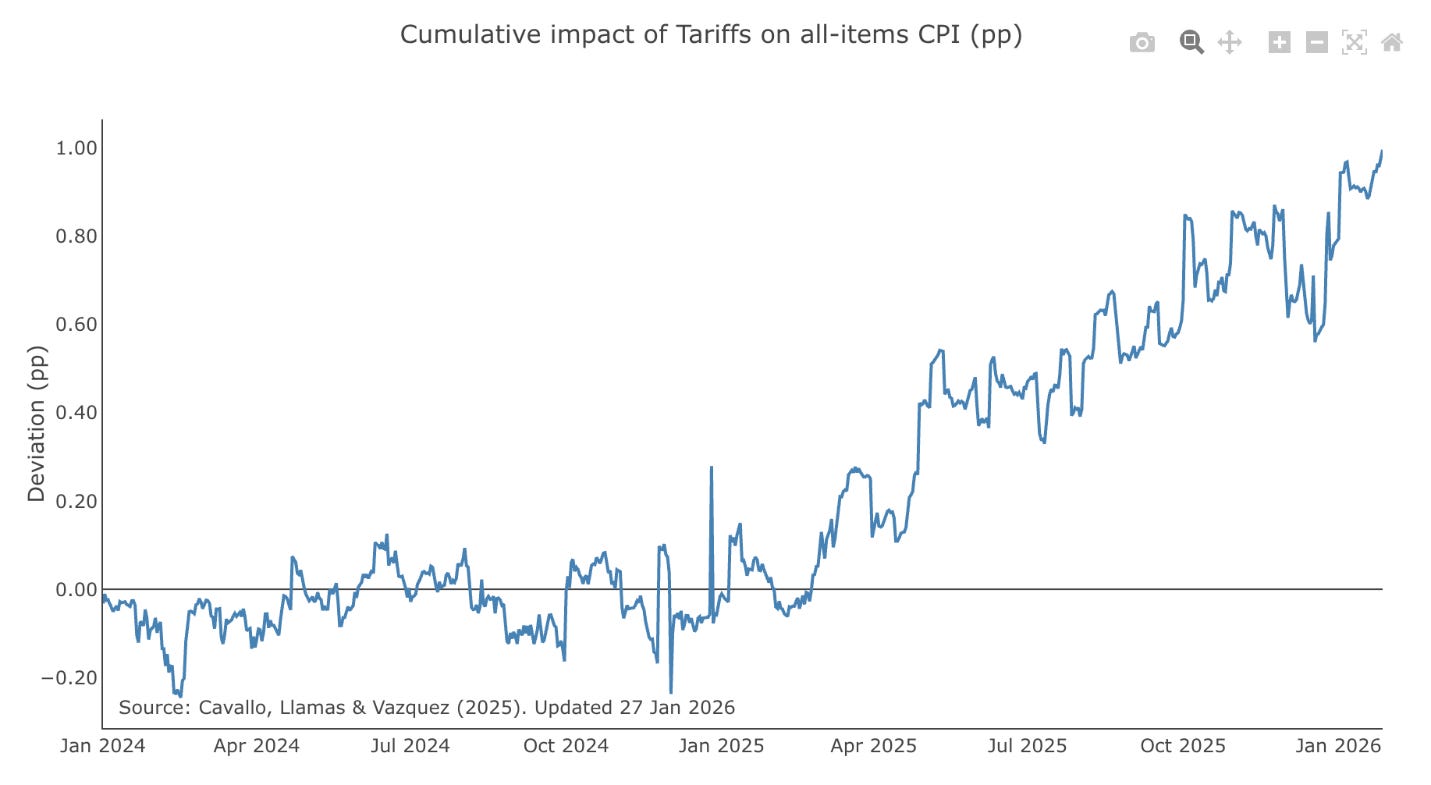
Donald Trump loves tariffs. Mainly, I believe, he loves them because they offer so much opportunity for dominance displays, allowing him to threaten other countries with economic ruin — usually via middle-of-the-night Truth Social posts — unless they bend to his whims. Economists may say that most of the damage inflicted by tariffs falls on American consumers and businesses, not foreigners, but Trump’s attachment to tariffs is doubtless strengthened by economists’ disapproval — he wants to show that he’s smarter than the so-called experts.
Furthermore, tariffs give him power without checks and balances. He can impose huge taxes on imports without having to go through annoying stuff like getting legislation through Congress.
Or can he? By any reasonable standard, most of Trump’s tariffs are plainly illegal. Two lower courts have ruled against them. The Trump administration appealed those decisions, and in early November the Supreme Court heard arguments on the case. Many businesses that have found it impossible to make long-term plans with the fate of the Trump tariffs in limbo eagerly awaited the Court’s ruling.
They’re still waiting. And I can’t see any plausible explanation for the delay other than Supreme cowardice.
Background: Most of Trump’s tariffs have been imposed by invoking a 1977 piece of legislation called the International Emergency Economic Powers Act, which the Congressional Research Service describes as giving the president “broad authority to regulate a variety of economic transactions following a declaration of national emergency.”
But we aren’t in an emergency. Trump himself keeps saying that everything is great — the economy is hot, there’s no inflation, we’re respected around the world. It’s not true, but that’s what he says. And he has been using IEEPA to impose or threaten to impose tariffs for many purposes that have nothing to do with economic policy. He imposed a 50 percent tariff on imports from Brazil to punish Brazil for pressing charges against Jair Bolsonaro, the Trump-like former president who tried to overturn an election loss. He threatened tariffs against European nations who stationed troops in Greenland as a precaution against a possible Trumpian attempt to seize the island from Denmark.
In the latter case Scott Bessent, Trump’s Treasury secretary, pressed on the nature of the emergency that would justify tariff threats, declared that “the national emergency is avoiding a national emergency.” Uh-huh.
I’m not a lawyer, but I talk to lawyers, and this isn’t a difficult case on the merits. Trump is clearly wrong on both the letter and the spirit of the law. And when the Supreme Court held its hearing, the tenor of the questions, even from conservative justices, suggested that they recognized that the administration had no case.
So why have we had three months of silence? Well, this isn’t a difficult case on the merits, but it puts the six right-wing members of the Court between a rock and hard place, not intellectually, but personally.
For a right-wing justice, ruling in the Trump administration’s favor in such an open-and-shut case would amount to admitting that you’re a pure partisan hack. And even the right-wing faction on the court is trying to maintain the fiction that it’s still a deliberative body, not a MAGA rubber stamp.
But to rule against the administration would be to hand Trump a humiliating defeat on one of his signature policy issues. It might also be very expensive. Tariffs aren’t the revenue gusher Trump and his minions like to claim: Even after the Trump hikes in tariff rates, customs receipts are small compared with other sources of revenue and have made only a modest dent in the U.S. budget deficit. But losing that revenue and, worse, having to give it back would be a financial embarrassment.
And it’s hard to see how, if the Supreme Court rules against Trump, the government can avoid paying back the money it has collected to companies like Costco, which has sued for a refund. If the Court rules that the tariffs weren’t legal, can the administration say, “No backsies” and refuse to refund money it collected illegally?
Right-wing justices don’t want to humiliate Trump, and they’re surely afraid of what will happen if they do. So they’re damned if they do the right thing, damned if they don’t.
When I’ve made this point in the past, some readers have asked why Supreme Court justices would be afraid of crossing Trump. After all, he can’t fire them, can he?
But to suggest that Supreme Court justices are insulated from pressure merely because they have job security is to misunderstand how power and influence work, especially within the modern right-wing movement.
Prominent figures on the right — and the Republican Six on the Supreme Court surely qualify for that definition — aren’t just members of a movement. They’re also part of a social scene — a scene shaped by the wealth and power of billionaires. They share in the privilege and glitter of that scene even if they aren’t outright corrupt — even if they aren’t all like Clarence Thomas, who, as ProPublica revealed, has taken multiple lavish vacations paid for by billionaire Harlan Crow.
To vote against Donald Trump’s beloved tariffs, delivering him both a policy and a political blow, would be to risk being ostracized and exiled from that milieu. If you don’t think that would matter a lot, you don’t understand human nature.
And more than social estrangement might be at stake. Violent threats against judges and other public officials, especially those denounced by Trump and other MAGA figures, have soared. Are you sure that a judge perceived as having betrayed Trump — and his or her family — would be safe? More to the point, are judges themselves sure?
So the right-wing majority on the Court is surely afraid to rule on tariffs — afraid to rule for Trump, because that would destroy what’s left of their credibility, afraid to rule against, because that would anger both the MAGA elite and the MAGA base.
So they’re procrastinating, even though the longer the tariffs stay in place, the more Trump is emboldened to tweet out bizarre, destructive and illegal policies and the more economic damage is done by uncertainty.
Their paralysis is understandable. But it’s also utterly shameful.
3 Likes
The SCOTUS will find for the First Felon with never-before-seen contortions in interpreting the law.
There is a reason Roberts has forced the clerks to sign NDAs.
2 Likes
The current SCOTUS bench was set at 9 to align with the number of US judicial circuits, so each justice could “ride the circuit” he was assigned to supervise (back when they literally rode from court to court). We now have 13 circuits, which means some justices are supervising more than one. So the Congressional rationale for expanding the court should be to align with the number of circuits as intended back when it was set at 9. And at present, at least two of the circuits are out of proportion with the others, so should be split up, giving us 15. Or more, if more splitting of present circuits were seen as desirable.
Increasing both circuits and justices would begin to alleviate the unmanageable and ever-growing case load the entire federal judiciary is currently struggling with.
Expansion brings the argument that any future Congress can further expand the court to pack the court in their favor, but this can be obviated in the law by requiring the number of justices to match the number of circuits, with a clearly defined rationale or formula for when the number of circuits needs to be increased.
With, for example, 15 justices, cases should then be assigned to smaller, randomly selected panels, just as is done in the circuit courts of appeals. For example, a case would go to a panel of seven justices, and a majority opinion would decide the case. This would avoid the “justice shopping” and tailoring of arguments to particular members, a common practice today that poisons SCOTUS jurisprudence. Further en banc appeal could be allowed, or precluded in the law.
Justices would be nominated, confirmed and appointed as they are now, but for fixed terms on SCOTUS, after which they can return to a lower Art.III court, enter the Senior Judges program, or retire outright. This avoids violating the apparent “lifetime appointments” following from the Constitutional language, “they shall serve during good behavior.”
Under the new law, appointments to the newly created seats should be delayed until the next presidential administration, awarding it one seat, or perhaps one seat per two-year Congress, and the same for each subsequent administration until the number of new seats are filled. The fixed terms, once enacted. would ensure each administration a certain number of appointments per term. Vacancies from deaths or resignations would stand as one of the present administration’s fixed number of appointments, and if they have used theirs, would become the first ones for the next administration.
All these things can be done by law without need for Constitutional amendment.
(edited to address becca656’s point below)
3 Likes
But unless the First Felon gets to appoint all of these new SCOTUS justices, the GQP will never agree to it.
And if, by chance, they do agree to it, we have no recourse on our side unless we own the Senate to keep the First Felon from making additional appointments that would keep the court forever conservative and subservient to him and his successors.
1 Like
The Utah Legislature is currently on a mission to destroy Utah’s court system. They intend to change how judges are appointed, how they are retained, and to effectively give the legislature right and power to remove a judge by simple majority. The proposed changes - if they were signed into law - would effectively place Utah’s judiciary under the control of the legislature. Instead of having an independent judiciary, we would have a judiciary that is another arm of the legislative branch. That would be very bad.
Republicans control everything about the state of Utah. But apparently control is not enough. They want absolute and complete dominance.
At present, I think Utah has an exemplary judiciary. On a personal note, I interned in CJ Matthew Durrant’s chambers when I was in law school. I am certain that he and I agree on almost nothing in the political realm, but I found him to be a fair and considerate judge who decided cases according to the highest standards of law and equity, even when he may have personally disagreed with the outcome. I liked all of the judges on the Utah SupCt that I worked with, even if they were arch conservatives to my arch liberal. I sincerely hope that Republicans don’t destroy Utah’s judiciary in their quest for dominance.
3 Likes
What we have to admit, and so far have not, is that Republican quest for power above all else has changed our institutions and especially the Supreme Court.
While I hate to sound like a broken record, this should have been obvious in 2000.
The point being as Merritt Garland proved, we cannot act as if nothing has changed.
That is Republicans in their quest for dominance have radically changed all government institutions at every level, both federal and state, and we have to grapple with that change and admit we cannot magically recast our institutions as they were before the onslaught least we have a Trump 3.
2 Likes
This story can be summed up in only three words:
Republicans are hypocrites.
To add a few more, Republicans’ moral (amoral?) center is the aggregation of power. They have no principles beyond that.
5 Likes
Chuck Grassley said that expansion “would erase the legitimacy of the Supreme Court."
Methuselah of the Senate upChuck and his sailing buddy Noah bid “Aloha” to the now-quaint notion of SCOTUS legitimacy long ago.
1 Like
“There are a lot of people concerned he’s not the same old Chuck Grassley,” said Eric Woolson, author of a 1995 biography of Grassley who once served as a Grassley campaign spokesman.
Many of Grassley’s recent actions, however, suggest he has evolved from being a fiercely independent moderate eager to sniff out fraud to being a stalwart Trump ally…
Grassley circled the wagons behind Trump’s nominee…Emil Bove. The ”vicious rhetoric, unfair accusations and abuse directed at Mr. Bove,” Grassley said in a speech, have “crossed the line.”
Former DOJ lawyer:
“How is the congressional majority not screaming bloody murder? We are watching the near decimation of DOJ in real-time, and Congress is sitting by doing nothing,” she said. “Does Sen. Grassley think it’s OK that people get fired for doing their jobs?”
At a September oversight hearing, Grassley passed up a chance to grill Patel on a series of terminations of line agents and high-level supervisors, including five whose abrupt and still-unexplained dismissals had generated headlines weeks earlier.
“He has been uncharacteristically silent,” said Mark Greenblatt, a Trump appointee at the Interior Department who was among those fired. ”It is unimaginable that the Grassley of a few years ago, the man who held nominees and fired off blistering threats at the smallest provocation to protect inspectors general, would be so silent in the face of these assaults.”
In answer to earlier statements about what the Palace might say about Andrew:
Palace ‘stands ready to support’ police in Andrew inquiries
I don’t think he’s getting off on anything.
If Chuck Grassley were really doing his job, he would take action on these issues:
Must. Avoid. “Getting Off” joke… 