This article is part of TPM Cafe, TPM’s home for opinion and news analysis.
This is a companion discussion topic for the original entry at https://talkingpointsmemo.com/?p=1368420

This article is part of TPM Cafe, TPM’s home for opinion and news analysis.
Excellent piece! The 1960s were the last time the US Gini coefficient, a rough measure of wealth disparity, declined. Had it not been for escalation f SoCal’s wars in Southeast Asia and some industries’ obsession with built-in obsolescence, we’d probably have bases on Mars, ended the Cold War a decade earlier, have a completely different relationship with China, and saved many species from extinction and natural services from degradation.
I’m not sure there was much meat in this article, however one statement just jumps out: “This was a living-wage paying job in 1968 — one could support a non-working wife and family.”
How many working class jobs are there today that pay enough for a family to have a home and pay the bills on that single salary?
I don’t have an answer for this problem, but that seems to be the crux of the issues. The rich get richer and the hard working class seem to continue to lose ground every year.
Interesting
“But he says the system has gotten skewed, with the richest 90 people owning as much wealth as the bottom half of the country combined.”
Factory workers (and today’s equivalent, the service worker) still work just as hard as back then and have just as many dreams of starting businesses or becoming middle class. But their standard of living has fallen since the 1970s while the cost of living has risen.
It’s next to impossible to save anything. Living from paycheck to paycheck with a medical emergency capable of bankrupting you is the norm. It’s like comparing apples to oranges. You cannot work your way through college or trade school. You will carry the debt for decades.
The raison d’etre of the republican party has become servicing the needs of the extremely wealthy:
A very small number of people on the right have been pouring money into this effort for decades. Jane Mayer lays out the plan in Dark Money. They are behind all of the right wing think tanks and lobbying organizations and ‘foundations’ that buy congressmen, senators, governors and presidents, and even write the legislation that gets signed into law.
The first step is overturning Citizen’s United. Then we need campaign finance reform, to get the dark money out of politics. But I fear this is a pipe dream.
As an aside - given the technological and productivity advancements of the last 50 years, the working class should be living better than ever, but that is clearly not the case. Labor unions have taken a beating since Reagan (PATCO was his favorite war), and that has been part of the problem.
Worker owned co-ops, that’s my push.
SoCal’s wars? Are we blaming Orange County for Vietnam?
SoCal was the name of Standard Oil Company of California. Their geologists rightly identified substantial hydrocarbon deposits in the South China Sea, which is extremely shallow, less than 100 meters on average. This was probably more important to the generals at the Pentagon than the French failure to keep up their local colonization of Vietnam. Remember, this was the heyday of oil geologists. It was the place to be. For example, Bunker Hunt, who was briefly the world’s richest man in 1958 based on an oil deposit discovered in Libya, was a board member of the John Birch Society and all for using the US government to achieve his “conservative” goals.
Nixon said the Vietnam War was over in January 1973, but the struggle goes on, just without the gunfire. And now we are on Hanoi’s side.
Thanks for that. Interesting, and mostly new to me.
(But I would have capitalized the acronym in its entirety. Having been born at Queen of Angels, I’m sensitive about SoCal. Sort of. [My post was in fact a joke, effectively asking for the true meaning in this context. You answered it splendidly.])
I was off to Vietnam in late 1968…I was there too so let me give my 2 cents.
The Democrats did not lose the working class. The working class bought into Reaganism like they did Trumpism all the while being warned by the democrats that in the end those choices would hurt them. They did it anyway out of a self destructive defiance, gullibility and fascination with tough talk. The GOP never hid what they were really about. Everyone knew what a “right to work law” was but those that it would hurt forced themselves to buy into the bullshit defense of them and they deserved what they got for that. That working class hung onto their GOP identity while year after year went by without an increase in buying power for them but their productivity went up and up. They knew what was going on but it just felt so fucking good to vote against the party of “nigger lovers” even if it set your family at near poverty.
The White Working Class and Rust Belters are a bunch of dupes and saps. All they’ve achieved in the last 40 years is the mass production of billionaires, stalled economic growth for themselves and immeasurable inequality. Come on folks…the working class bought into the Blue Collar Billionaire bullshit ( or went along with it knowing it was crap ) because it made their irresponsible politics feel good.
During that 40 years the Democrats made clear they desired better healthcare and pay for working class people. They wanted educational opportunities for the kids of the WWC to be like they were in 1965…but fuck that…time card punchers punched a straight GOP ticket, suffered but sang in tune with the GOP’s “it’s the libs that done it” rag. The Democrats never abandoned the WWC. The WWC bought into Reagan tough talk, Bush tough talk and Trump tough talk and now they bitch about their lot.
The Democrats must continue to be the genuine party of the working class. It’s up to that working class to get over their lust for the GOP all talk no walk tough guys and sign onto that Democratic agenda. I hope they do but fuck that “I didn’t leave the Democratic party…it left me” Reagan bullshit. The Democrats never pushed the working class away. The working class was dumb enough and gullible enough to fall for Republican bullshit and move themselves to the Right. Fuck em.
Not Reaganism really. Remember prior to this was the Southern Strategy. That was where the identity politics become the driving force as they realized their raw numbers were declining. Reagan, was where the union busting really began in earnest. As with making ‘Gov’t the enemy’ so were Unions redefined as being greedy and only out for themselves. (of course oblivious to they are part of the ‘themselves’ that benefit) There’s also the massive amount of Gerrymandering. I’m not sure sure the working class as a lust for tough talk. There is however a large class ever more fearful of the browning of America.
This is true:
Workers believe in themselves. They want the opportunity to work hard and provide for those who depend on them. If you take this hope away, they will vote for anyone who promises its return. Even if it is Trump, a wealthy con man who has spent a lifetime stifling their brethren.
And the crux of “wanting the opportunity to work hard” is the conundrum. Someone wants the product of your work. If you want “the opportunity” to work hard. And they want you to work hard and make them money, the hard worker focusing on the simple goal of having a place to go and work, instead of a dream of improvement and growth becomes the force driving inequality.
You gotta never be satisfied.
For what its worth, myself and numerous others I knew migrated from the campus to the factories with the intent of winning the support of workers to end the war in Vietnam and redirect our nation’s priorities. Some - the very dedicated - stayed throughout their working lives.
While I concur with Mr. Russo’s sentiments this feels like a different time. Of late I have been more intrigued by Charles Blow’s discussion in his recent book about youth migration to Vermont during the same era that Mr. Russo is writing about. Blow maintains that the migration of hippies to Vermont effectively transformed VT from a NH type Red State to a Blue State.
Today, we are have a large number of retirees and at home distance workers who could relatively easily relocate from deeply blue or deeply red states. It may seem crazy, but the Vermont experience could be replicated in places like WV and SD and elsewhere. I don’t see Senator Manchin tacking to the middle right as federally disenfranchised voters from DC relocate 90 miles away to push him to end the filibuster.
After all, the “hippies” made these changes in the 60’s when the challenges facing our nation and the world were not nearly as dire as now (i.e., global warming). And we have substantial surplus of very dedicated and deeply concerned blue voters living in places where their national votes are effectively meaningless.
Peace
Yes to many of your ‘points’…however, the Democrats can craft whichever message works, they can propose and even implement policies that will help the middle class but if the working man CHOOSES to listen to the lies and distractions it simply doesn’t matter. Case in point…the INFRASTRUCTURE bill which will bring middle class jobs back to America, increase manufacturing, help achieve the ‘American Dream’ won’t ‘resonate’ if the Republicans keep lying about the bill that THEY SUPPORTED under both Bush and Trump and then never did anything about it.
Agree, and I am tired of pundits accusing Democrats of abandoning the working class, especially this pundit whose familiarity with factory workers might be from as little as a summer spent working with them on his way to becoming a media executive who traffics in platitudes and romanticizes blue collar workers.
The 1960s are not now.
First, anecdotes about workers you met at a summer job don’t make a statement about the broader mindset of the “working class.” Those high-paying (unionized or near-union-scale, the latter to keep the unions at bay) jobs were more typical, there were fewer cultural conservatives in the mix (these are people who believe in miracle economics for the right kind of white Christian males), and the author’s location on Long Island, rather than a marginal branch plant in Kentucky, tend to bias it a little bit. (At the time, high-value plants with high wages were already somewhat in decline, but the footprint of union autoworker, steelworker, construction worker, truck driver, etc. jobs held it up.) In the broader middle class, there was immense hostility to unionized workers. (As recently as the 1980s, union workers who worked overtime earned more than a lot of engineers who worked the same number of hours.)
It’s all cultural. In the 1960s, the people who started the SDS had never interacted with Archie Bunker, a faction that is far better organized than anyone has ever recognized. Opposition to the Vietnam war was an artifact of the middle- and upper-middle classes (who frequently didn’t go anyway – my prep school offered draft-avoidance seminars, for example, as did the affluent public school districts in the surrounding suburbs.)
In the mean time, the mindset of the professional middle class changed dramatically. Some of this was a response to the escalating influence of religious fundamentalism (few well-educated people; I’m excluding the products of “Christian” colleges and the organized campus Christian groups who helped their fellow believers get through their academics.) Remember that the break from Civil War era politics was rather short: it started when Japan bombed Pearl Harbor (a mistake by Japan; the Nazis had a huge fifth column in the US, but the Japanese were a feared racial minority and everyone was down with blowing up and shooting them. FDR was able to use this racism, and the undeclared submarine warfare off the East Coast in the month before Pearl Harbor, to declare war on Germany.)
First, a look at pre-war America. Upper-middle class women (and the upper middle class was a lot more relatively affluent than it is now) really did stay at home, although they could of course afford a nanny. Working class families did not, but the upper echelon of blue collar workers (and, after the 1920s, many people in union jobs) could also afford nannies to look after their children. And you could hire white, Christian, English-speaking household help for the cost of giving them a bedroom and three meals.
Two things happened in the 1950s. First, during WW2, a lot of women worked in war factories (remember “Rosie the Riveter”, an image that infuriated Christian conservatives who were not terribly anti-Nazi to begin with). After WW2, all those mustered-out service people needed jobs and housing. The jobs were made in part by getting rid of female employees (who were supposed to snare a returning veteran and stay at home and make babies), and in part by having the government heavily subsidize all-white suburban housing. And the idea of being a “homemaker” and having a lot of discretionary income, was attractive. (US car makers emphasized automatic transmissions heavily once they became available since they assumed this made cars more attractive to women that non-synchromesh stick shifts; this meant that the “little woman” could drive into downtown in her own car to go shopping at a department store.) By the way, the department store hit its heyday in the 1920s, when there was a large population of married women with free time and disposable income to be their target market. This was still the case in the 1950s and even the 1960s and 1970s (they moved out to suburban malls in the early 1970s). They were killed by demographic factors. Educated people in my generation and after were not attracted to them; the blue-collar demographic was more inclined to go to K-Mart, then WalMart, and in the “blue states” smaller specialty stores started popping up to service upscale middle class shoppers.
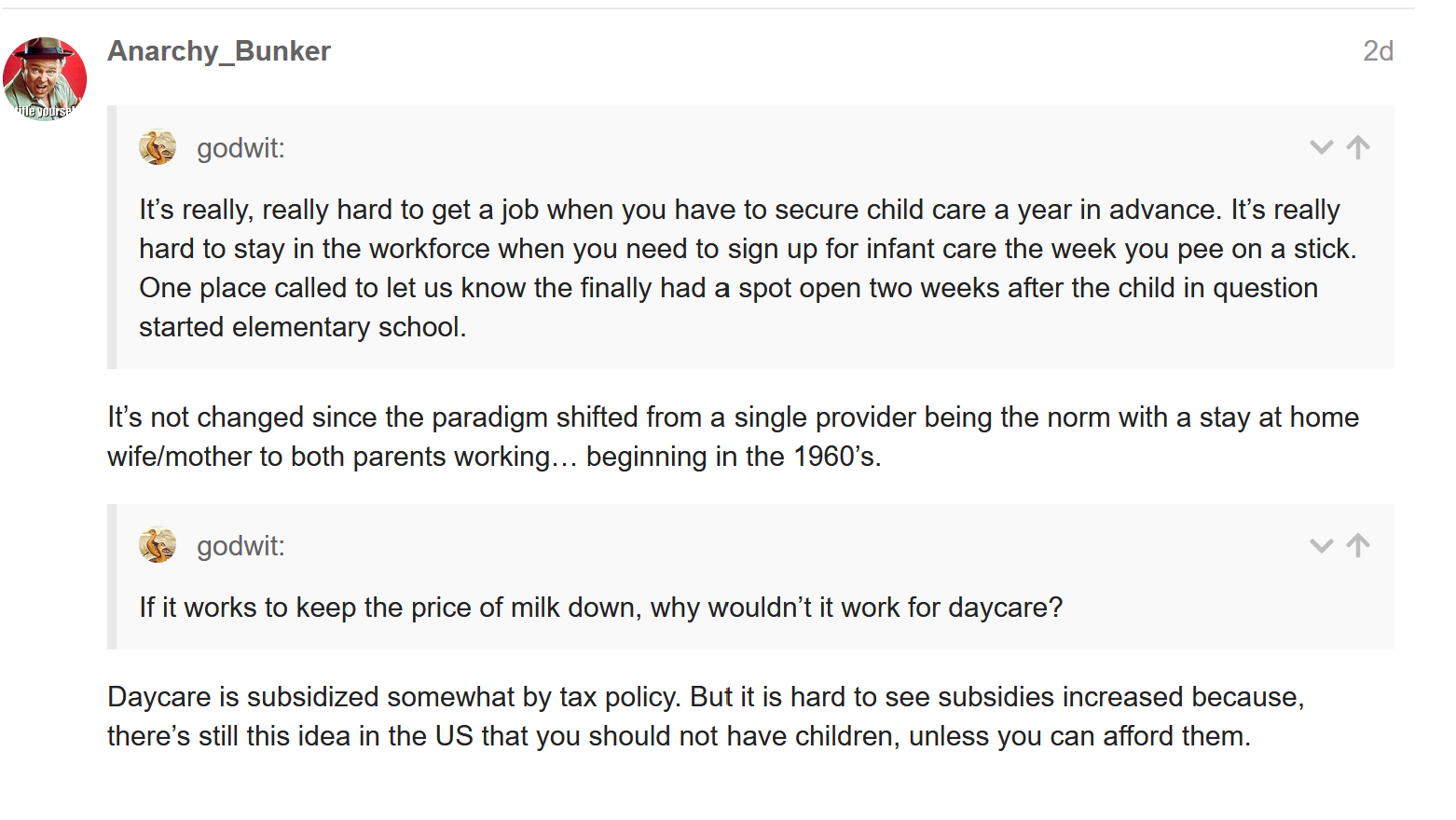
Educated women tend to work because they want independence (and because they had careers before they were married and had children) and because their earning potential is usually worth it. A lot of lower-middle class women work to be independent of their often unreliable husbands. At some point, the two paychecks become a necessity anyway. However, most downscale workers always had two working parents.
In most civilized countries (basically, non-English speaking countries) there is a much larger infrastructure of company- and government-provided daycare, not to mention generous maternity and paternity benefits. This is difficult to get done in the US because the religious right will inevitably stand in the way. Phyllis Schlafly (remember her? I would personally prefer that my 1970s memories be of disco than of her ilk, even though disco is a crime against music) espoused women to be subordinate to husbands – while pulling down a huge income as a high powered lawyer. When the ERA went down, the small minority of female opponents in my college class were despised by everyone, including the men. (Even the toxic-male frat boys tended to favor it.)
This is an important point. “Conservative” white blue collar workers are mostly found in the south or in exurbia. Urban white blue collar men outside the South, while not a bastion of liberalism, are not nearly as heavily Republican. However, a lot of the remaining manufacturing base in the US (outside of vehicles, airplanes, and the like) are now located in smaller plants in rural areas, often in places like Appalachia. These low wage jobs account for a lot of the US productivity gap (the Big Three’s workers are among the most productive in the world).
The bottom line is that our friends in the SDS in the 1960s underestimated the extent to which cultural distinctions matter more than economic ones. This is about when Nixon et.al. rediscovered the Confederate fifth column and learned how to use it.