
Discussion for article #235075
Corporate civil rights are an interesting way to look at it. I question the legitimacy of corporate power, implicit in the calls for triple-bank-shot boycotts to pressure Indiana businesses or Final Four advertisers to lobby the government to change the law. It simply shouldn’t be the government’s job to do the bidding of big business.
3 Likes
Are corporations people?
Number of people incarcerated in the US (2011): 2,266,832
Number of corporations incarcerated in the US: 0
Corporate personhood is a legal fiction: something that everyone knows isn’t true but that is accepted in order to meet some legal requirement. When corporations can be put in prison, then they’ll be people.
8 Likes
Chalk this up as another example of confusion, foremost among businesspeople themselves, between the privileges and preferences that businesspeople demand, with what’s actually good for business. It’s a trick worthy of Penn & Teller, these independent retailers nailing their own coffins from the inside.
Sooner or later, gay couples are going to say to hell with it. It’s just a damn cake and flowers are flowers. Rather than be judged by an independent businessperson who doesn’t want their business, people will just get a generic Wal-Mart cake and be done with it.
You know how anti-gay bigots used to endlessly repeat “no special rights” when trying to deny even the semblance of equality for LGBT persons? I think that argument should actually have force when applied to corporate persons. As long as corporations are potentially immortal, cannot be imprisoned or – in large part – otherwise effectively sanctioned by criminal law, the “civil liberties” they keep demanding do amount to special rights.
I wonder how this would work if any corporation asserting civil liberties had to, say, agree to be limited to the old three score and ten, with its estate subject to the usual taxation upon distribution to any heirs.
4 Likes
Don’t know who originally said it, but “I’ll believe corporations are people when Texas executes one.”
4 Likes
Presumably Robert Reich
http://robertreich.org/post/35848994755
However, I presume it’s just an aphorism that he happened to pick up since it was already seen on placards in Zuccotti Park in 2011:
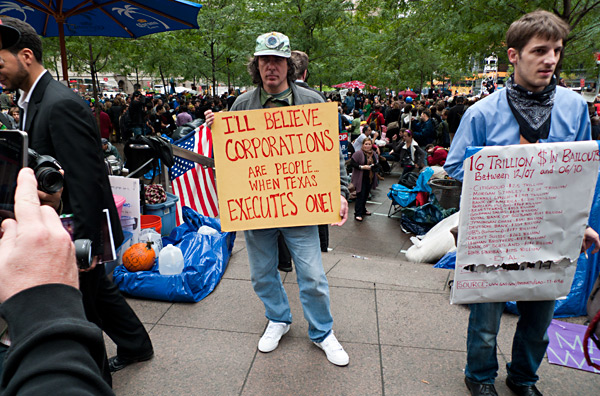
3 Likes
Both sides are missing the point of the debate. It’s about free expression. If you disapprove of what someone does, you have a right to express your disapproval by withholding business from them. Which is exactly what the people who want to boycott Indiana are doing. If you disapprove of someone’s actions by refusing to do business with them, that’s wrong, so we’ll express our disapproval of your disapproval by withholding our business from you for withholding business from them. Clear?
But I confess I had really only thought of small businesses here. I really hadn’t thought of what might happen if large entities got involved. It’s actually happened. In some places, landlords have a blacklist of people who have taken landlords to court (it may be illegal, but prove it). So if you criticize the banks, you might find yourself unable to open a bank account.
But yes, we also have the predictable “corporations are not people.” US Code Title 1, Chapter 1, Section 1 - the VERY FIRST PAGE of US law - says: “the words “person” and “whoever” include corporations, companies, associations, firms, partnerships, societies, and joint stock companies, as well as individuals;” How do you strip the rights from an organization without stripping the rights of the individuals within it?
It’s not in the Constitution? No, but the Ninth Amendment says: “The enumeration in the Constitution, of certain rights, shall not be construed to deny or disparage others retained by the people.” In other words, just because it’s not in the Constitution doesn’t constitute grounds for denying it.
I see this as more than just the anti-gay issue. This is an attempt to turn long-established definitions and referents to create semantic confusion to pervert Constitutional law into something never intended by the Framers and into meanings largely harmful to segments of our society. Orwell would have understood.
““When I use a word,” Humpty Dumpty said in rather a scornful tone, "it means just what I choose it to mean - neither more nor less.”
Orwell, of course, laid all this out in his “Politics and the English Language”. I couldn’t improve on that.
3 Likes
That’s the rub with me. A small business is most likely run by an individual, probably the one(s) who have their personal fortune on the line and engage in the direct activity of the business. The larger corporations become, those selfsame owners/shareholders no longer engage in the direct activity of the business, they become an avatar of the financial resources wielded by the company. The larger the company/corporation, the more abstraction between those who wield the power of the corporation and the direct business activity… I think the Undercover Boss television show demonstrated that. As well, the larger the corporation/company, the farther away any of those who control the financial resources are from any actual consequences of their actions… CEOs and other ‘professional’ executives are literally in a win-win where they increase their fortures regardless of the performance of the company.
In the end, the largest corporations are then protected from their own failures by we the people. Talkin’ about original intent in the Constitution!
If these corporations want rights so badly, maybe they ought to get out in the street and protest. Don’t worry, we’ll wait.
1 Like
Wow – powerful message. And it confirms what I have been fearing was happening for a long time now. This article is TPM at its best.
1 Like
From Elizabeth Warren’s mouth to God’s ears. Corps don’t need to be persons when they get all the benefits and suffer none of the consequences of illegal behavior.
1 Like
One thing to keep in mind, though: most corporations are chartered by states. So explicitly restricting the rights of corporations might be regarded as a state-level issue. Amending incorporation statutes to include " . . . no articles of incorporation shall be construed as granting any corporation any right of conscience, religion, or free speech, except insofar as a statute or legal decision imposes an unconscionable restriction on the rights of individual proprietors or shareholders"—or something like that (I’m not a lawyer)—might make it possible to argue that you can separate corporations from shareholders when considering a law’s effect.
Because that’s the issue—not whether corporations are people, but whether shareholders’ rights extend to collective action through corporations in addition to the rights they hold as individuals. At least as far as I understand it.
Corporations can be put in prison, but it would take a congress full of Warrens to enact the law:
Sentences are the same for real or corporate persons, the difference being the corporation serves its time by
- a freeze on all trading of their stock for the term of the sentence.
- a freeze on all transfers (cash/options/etc) to board members for the
term of the sentence. - cancelling all board/executive compensation agreements.
- an appointed financial overseer for the term of
the sentence.
Jail takes away a person’s freedom of movement. The corporate equivalent would to restrict the movement of its capital. Particularly to stockholders at the time of an offence.
This is all a fucking DISTRACTION!
“Corporate civil rights”. This is bullshit on every level. A corporation is a legal fiction; it’s a piece of paper.
What is REALLY going on is an attempt to create corporate sovereignty. That is corporations that are utterly EQUAL to nation states in powers and rights. It should scare the shit out of all of you. A corporation can suddenly declare itself a sovereign entity and render all shares of stock null and void, leaving investors holding worthless scraps of paper. With the cash reserves companies like Apple, Verizon, GE and the like have would make them very powerful. Imagine Emperor Bill Gates, or King Tim Cook. Remember, corporations are autocracies. Imagine company real estate instantly acquiring the status of sovereign soil of the Kingdom of Apple or the Microsoft Empire.
There IS a downside: people can incorporate themselves…
Citizens are not just economic animals. Citizenship entails more than just the economic sphere of life.
Should corporations be granted the full rights of citizens when they represent a narrow slice of what citizenship is all about? Corporations may be legally required to maximize profits–and even if they aren’t (there’s a debate about that), they act overwhelmingly as if they are. The dominant ideology of maximizing shareholder value has been reinforced by decades of incentivizing senior executives with stock options and restricted stock, where every dollar rise in a company’s stock can mean hundreds of thousands or even millions of dollars in the CEO’s pocket.
So for a corporation, offshoring jobs and delaying action on climate change, for example, can make perfect sense. For a full-fledged human citizen, quite the opposite might apply.