

So when will SCOTUS overturn this one, too?
It doesn’t seem likely. This ruling was based on the state constitution, not the U.S. constitution. Unless the U.S. Supreme Court can find some basis for overruling a state court on this issue, this ruling will stand.
That’s what I vaguely remember from civics class a long time ago. As long as the State Constitution does not conflict with the US Constitution, the Supremes normally defer to the State.
This was the harshest, awesomest decision possible. It was also thought to be the least likely. This is a monumental win for Democrats!
I have to agree with kumquat16. The federal count would have to rule that the PA Constitution’s provision violates the US Constitution, which I don’t think they will do because that would open the floodgates to all manner of changes to state constitutions. Generally, unless a critical US Constitutional question is at stake – and it’s hard to see where there’s even a plausible argument for a federal issue which is necessary for the federal courts even to take jurisdiction – SCOTUS won’t even take the case.
This Goofy kicking Donald Duck resident is elated at the news. Hooray!
So, at this point, does anyone even have a guess as to how many PA seats a fairly drawn map could flip?
Yes. SCOTUS generally isn’t in the business of second-guessing a state court’s interpretation of a state constitution.
For example, the conservative majority was quite happy to shove the Florida Supreme Court out of the way in Gore v. Bush.
The goal of the GOP and its conservative friends on SCOTUS will now be to make sure that an alternative map doesn’t take effect for the 2018 elections. They get an important victory just by delaying a new map, even if they can’t keep the old map until the next redistricting after 2020.
Luckily, Pennsylvania has a Democratic governor and a Democratic Attorney General. The legislature has some options, due to its role in drawing district maps, but they are handicapped without having the rest of the state government on board.
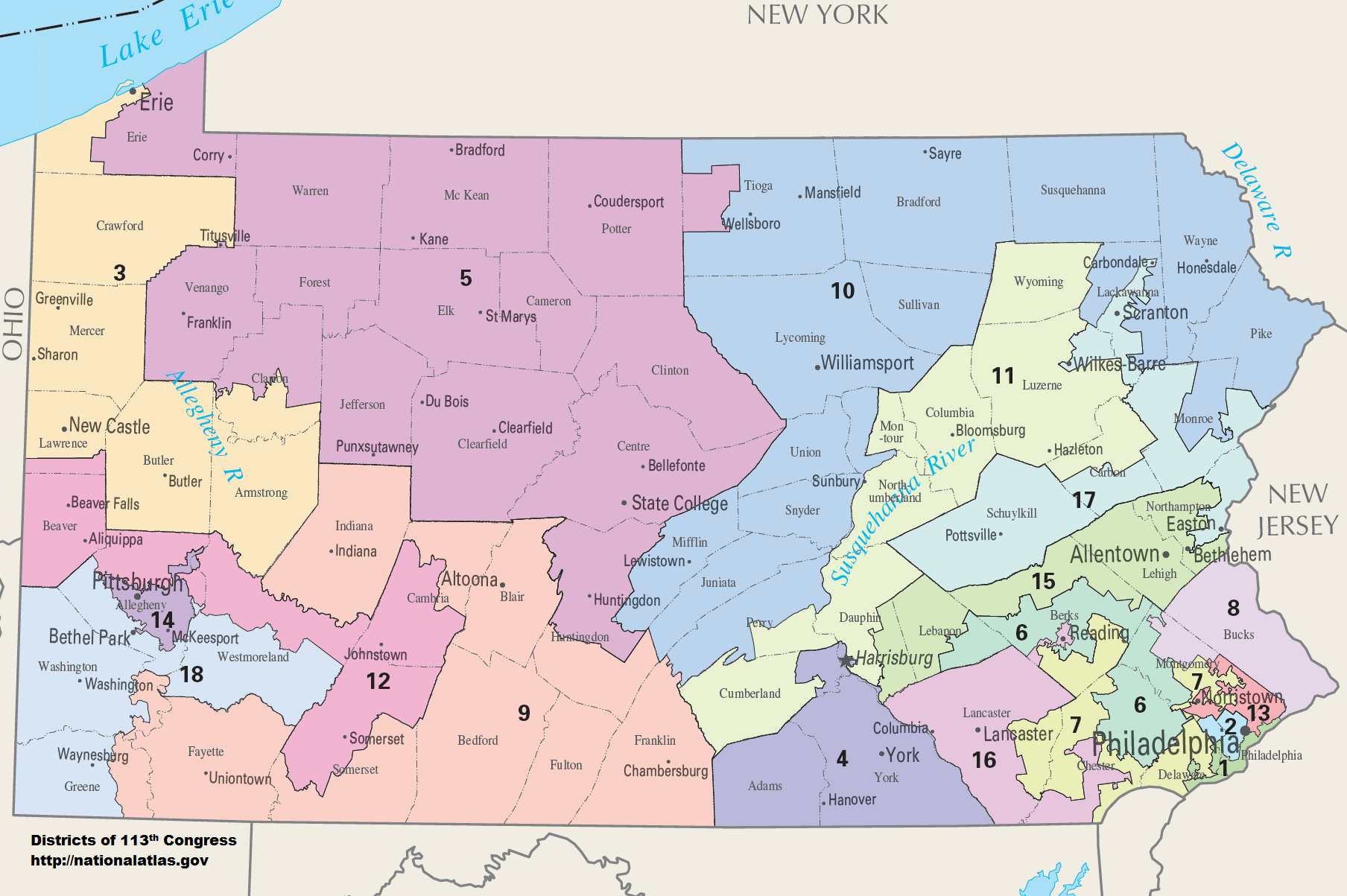
This is huge. That 18-13 split in a state that voted essentially 50-50 in the last election is unconscionable, and I hope we will see a very different result this November. Hoping the deadlines hold and that the boundaries are redrawn in time to affect the special election in PA-18, which buries part of Pittsburgh under the mountain of conservative voters in rural Southwestern PA.
There is no chance that the Supreme Court will take this case. A state constitution may grant greater rights than the U.S. constitution, but not fewer rights. Thus, the PA Supreme Court may interpret “one person, one vote” more expansively than the U.S. Supreme Court, whatever the outcome of Gill v. Whitford turns out to be. This case poses no federal question that I know of. There is no federal right to gerrymander or for the majority party to draw Congressional district boundaries for the purpose of maintaining party control.
My old firm worked on this case. I’m so happy for them.
Gore v. Bush turned on the interpretation of the Equal Protection Clause of the 14th Amendment, not state law.
I’m positive that my Trumpster neighbors here in south central PA will lucidly and rationally discuss the court’s ruling, and come to the conclusion that gerrymandering is an affront to democracy.
Statistically, the Democrats should have 9 of the 18 seats, instead of the current 5, maybe more because of the Democratic advantage in voter registration. Of the current districts, even with gerrymandered boundaries, 3 or 4 are likely to swing in a year with strong Democratic turnout.
Congratulations to all involved in this momentous decision. Really great news for a Monday. The League of Women Voters was an initial party (believe they were thrown off eventually), individuals, and several law offices involved from at least Philly and DC.
“The Pennsylvania lawsuit, filed by the League of Women Voters of Pennsylvania, relied on the state constitution, which means the court’s decision cannot be appealed to the U.S. Supreme Court.” (Reuters)
“Senate Republicans immediately vowed to request a stay from the U.S. Supreme Court, saying they would file their request by the end of the week.”
“Michael McDonald, a redistricting expert at the University of Florida, wrote on Twitter that a new, more neutral map would likely create four or five Democratic-leaning districts and erase the incumbency advantage of Republicans.”
I’m positive that my Trumpster neighbors here in south central PA will lucidly and rationally discuss the court’s ruling, and come to the conclusion that gerrymandering is an affront to democracy.
I’m sure they won’t link George Soros to the decision in any way either…
Good question, for sure. Arguably, since the Pennsylvania decision was based solely on the Pennsylvania constitution, the US Supreme Court would have no jurisdiction. I concede, however, that since Bush v Gore, the US Supreme Court has traded in its judicial robes for MAGA hats, so it’s anyone’s guess what they would do.
The times, places and manner of holding elections for Senators and Representatives, shall be prescribed in each state by the legislature thereof; - US Constitution, Article I, §4
So the GOP, being the self proclaimed party of the Constitution and protector of States’ rights, immediately declared its intent to ask the U.S. Supreme Court to step in and halt the decision.
Wasn’t my intention to imply that state law was involved, only that the state Supreme Court’s authority in the matter of state law becomes irrelevant when SCOTUS finds (or fabricates, as in Gore v. Bush) a Federal issue that takes the matter out of the hands of the state court.
With a little over half the vote and registrations, Democrats would have about half of the seats.
BUT general over-density of Democrats in urban areas gives a structural effect similar to a gerrymander, unless one very consciously tries to counter it. My guess is we should be able to end up with in the range of 7-9 of the seats in the state (with then 9-11 going to Republicans) in an even year.
BUT #2 2018, hopefully, is far from an “even” year, and given a +15% vote advantage I’d expect around 13-15 seats for Democrats and 3-5 for Republicans coming out of the state (that is, I think with properly-drawn maps we will likely end up with 3-5 districts which are at least 58% Republican, which is what it will take to survive a general 15% swing).