
A true mensch. R.I.P. Mr. Wiesel.
3 Likes
He died of a broken heart over the rise of Donald Trump.
I do not throw around words like "saintly,’ but if ever there was such a person as a “secular saint” it was Wiesel.
A precocious reader, I read of the Nuremberg trials trials at age 9 in Life magazine, our pre-TV window on the world in a small town in PA. Given his experiences, I would been fraught full of such hatred that it would have consumed me unto an early death. . Not him. That makes him a saint.
1 Like
“There’s a long road of suffering ahead of you. But don’t lose courage. You’ve already escaped the gravest danger: selection. So now, muster your strength, and don’t lose heart. We shall all see the day of liberation. Have faith in life. Above all else, have faith. Drive out despair, and you will keep death away from yourselves. Hell is not for eternity. And now, a prayer - or rather, a piece of advice: let there be comradeship among you. We are all brothers, and we are all suffering the same fate. The same smoke floats over all our heads. Help one another. It is the only way to survive.”
― Elie Wiesel, Night
3 Likes
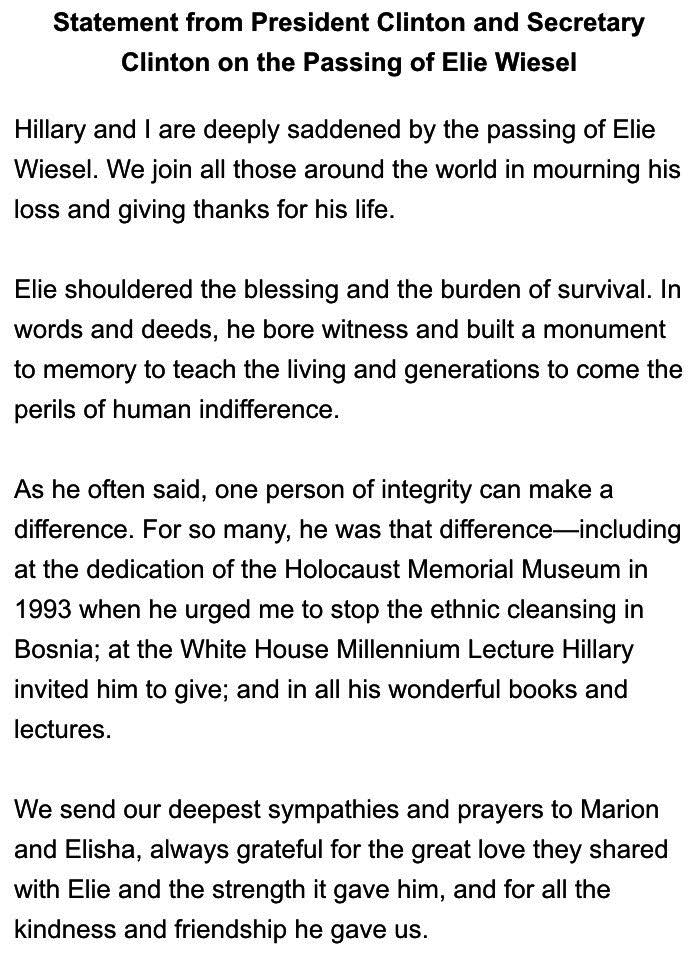
"We join all those around the world in mourning his loss" —Hillary and @BillClinton on the passing of Elie Wiesel pic.twitter.com/HNVH0LlWpr
— Hillary Clinton (@HillaryClinton) July 3, 2016
3 Likes
Real.
1 Like
I had a teacher in high school who was musically gifted. He was in the Army band. What did the bandsmen do when not playing? Graves registration. I believe he’s still alive. He has at least ten large binders of photos he took in the death camps. He said he’d give them to the Smithsonian upon his death.
The debasement and horror that I saw in those photographs will never leave me. I can not image living through such twisted acts.
I am not sure. He attended the Netanyahu speech to the joint session of congress as part of Netanyahu’s entourage arranged by Bill Kristol and the hateful Sheldon Adelson. I wonder if he ever spoke out about the Likud and its increasingly extreme partners.
2 Likes
Vote.
1 Like
Such an extraordinary life. R.I.P.
According to Steven Ambrose, most graves registration men were African Americans. Even wonder who cleaned up the bodies on, say, Omaha Beach?
I’m of muddled mind on this, perhaps because I’m of muddled heritage. Before me are Polish and German Jews who left for America, who fought in Europe in U.S. Army uniforms, and their relatives who stayed and perished. Alongside them are German Catholics who left, and also fought in Europe, and those who stayed and may have participated in atrocities as Nazis.
Wiesel was never able to achieve moral clarity on the issue of the Palestinians, when just such a voice was required. Perhaps, as with Bitburg, it would have fallen on deaf ears regardless. But it would have been valuable witness no matter the outcome.
I’m choosing, despite his lack of fulfilling every opportunity to stand against oppression, to remember the central role he played in forcing western society to remember the holocaust. As much as I would have liked him “to do more,” human beings are fragile vessels, and I imagine he bore as much sorrow as he could hold.
I am also of muddled heritage. My first awareness of the Holocaust came decades before I knew the name of Elie Wiesel. My knowledge of the Holocaust came first from my parents and older siblings. It was part of my schooling and religious instruction (Catholic). I was in my late 20s before I first heard of Wiesel. During the late 70s and 80s my memory of him is that of his unconditional siding with the Begin, Shamir and Sharon governments, and of reading critiques of his celebrity. I am probably in a minority of opinion, but I do not consider him the major cause for the modern consciousness and memory of the Holocaust. I do, however, remember the side he constantly took during a very ugly time in Israeli politics. His appearance at the Netanyahu speech in support of the Adelson/Kristol/AIPAC attempt to bully the President and influence American opinion is consistent of my memory of him in the 80s.