
So the carbon-capture approach!
3 Likes
Science is my North Star.
4 Likes
Sometimes change happens fast. Just 10 years ago, coal was still king in the US. Now,
not so much:
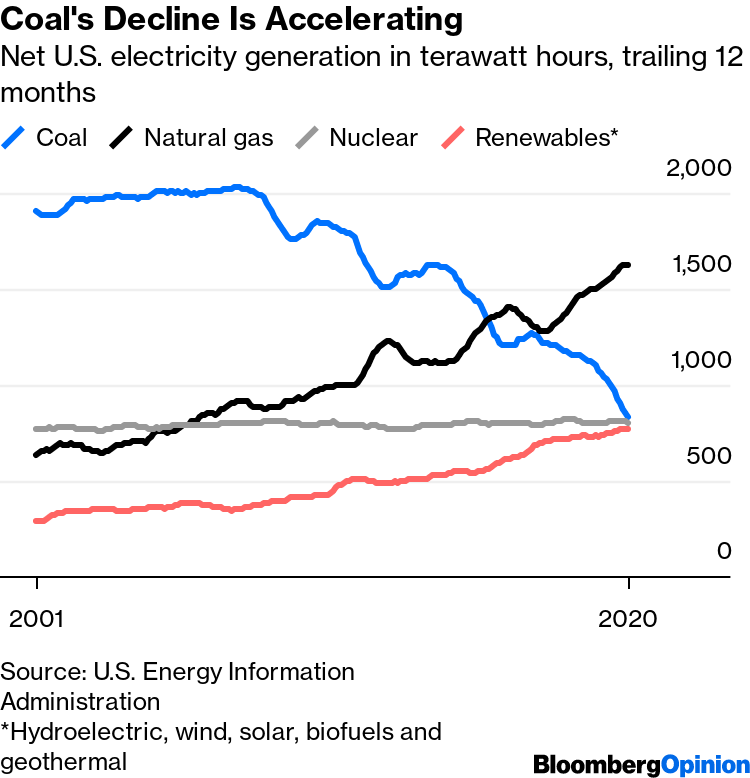
Both renewable energy and battery technology are undergoing rapid innovation that continues to reduce costs. Besides fracking, there really hasn’t been any similarly successful innovation in fossil fuel technology that would make them cheaper (e.g. CCT has seen much development, but will always increase fossil fuel costs, not lower them).
This is not to say that fossil fuels won’t still be around for decades. However, I expect to see many fossil fuel companies seek out federal/state bailouts for their now-unprofitable plants, like they did with HB6 in Ohio.
4 Likes
Because of the externalities and our own ignorance of what this 160 million-year-old hydrocarbon soup called crude oil was actually worth, we have spent the last century altering our atmosphere and ocean chemistry. The irony is that crude oil, which might actually be worth $1 million a barrel, dropped to minus $2 a barrel on the spot market this year. The number of active gas fracking wells in the US has fallen by 80% since 2014, the peak of the gas boom. One amazing feature of US society is that nearly every adult can tell you what the price of a gallon of gas is, but few can say what the price should be. The price of a clean fuel, in contrast, needs to be low enough to encourage decarbonization. Germany, for example, thinks hydrogen might be the answer.
2 Likes
today’s students are likely corrected if they add a few feathers to his ass
The first two I look up, Exxon and Chevron, haven’t notable year-over-year gains for more than a decade. Their stock price is about where it was in 2006. No one is getting rich off long term increases in fossil fuel stock prices.
What makes their stock attractive is the above-average dividends they pay. Around 5% currently. There won’t be a shortage of buyers to scoop up any shares that NY dumps.
1 Like
More importantly, China does too.
I sold half of my PLUG holdings yesterday and I’m hoping for a significant pullback to reload.
2 Likes
Yes, and I’ve been watching the decline with a smile for years. Coal is still the largest source of CO2 in the world yet. A few years ago, the entire global transportation industry (everything) emitted 22% of the CO2. Coal was at 42%. Not only because of the CO2 footprint of coal, because of the toxic metals released by burning coal also. It’s a filthy fuel and not needed. We can get along without it.
2 Likes
If you do some research, you’ll see NG production has most likely gone up, but because of better well fracking techniques, the number of wells have decreased.
1 Like
Coal is also one of the sources of black carbon deposition. Normally, we just think about the havoc it plays on glaciers and polar regions, but it affects everything indirectly by changing the reflectivity of the planet. For example, dissolved black carbon in the sea changes the Ph of seawater. Pre-industrial era, the pH was 8.2, today below 8.1. pH is a logarithmic scale! As the seas become more acidic, crustacea, corals, etc. cannot form their shells.
1 Like
 !
!
Natural gas is a transition strategy. Here in California we now have one operating coal-fired plant, the Indian-owned Argus plant in Trona. Everybody else has moved to gas or renewables. Denmark, which has an ambitious transition strategy, is moving away from gas as its major offshore Tyra field declines. One idea is to repurpose wells to carbon sequestration.
Denmark has been dreaming up and implementing a very ambitious climate policy that sets a 70% emission drop by 2030 (compared to the 1990 baseline) and going carbon neutral by 2050. In view of Tyra’s gradual decline in the 2040s and no other alternative to replace it, the timing could hardly be better. The Danish government will also set up a financing mechanism to promote offshore carbon storage, endowed with some $550 million. Oil companies active in Denmark’s offshore might even use the Danish green drive to create new business opportunities – companies like INEOS or Wintershall Dea have already expressed their interest in repurposing their drilling infrastructure into carbon dioxide storage hubs (the CO2 would in effect be stored below the seabed).
4 Likes
Good market timing!
1 Like
The stale price of the stock makes it a vulnerable long term investment and, a mid-range risk in the short-term because a single piece of bad news like say a Court finding of liability for clean up of abandoned wells amounting to billions of dollars in fines batters the price making it’s new normal 15% lower as dividends are slashed to cover the fines.
Under this scenario, an investor loses 15% of his principal which amounts to three prior years of earnings. More and more large funds are seeing this risk and just don’t want to get caught when that moment comes.
Eventually, once all the big players get out, only the little guys become exposed and then that’s when it all starts to go south.
1 Like
Can anyone name three major industries that were inconvenienced and changed their ways because of… divestment?
The time to not invest in them was 150 years ago when the stock was sold.
Hi! To find out what I can do, say @discobot display help.
As a way to drive down the industries stock prices, then no
If divestment campaigners’ only aim were to move markets, they’d have a point. It’s near-impossible to prove that divestment alone has ever had any financial bearing on their targets. Even the impact of divestment campaigns widely considered a success—like South Africa’s apartheid in the 1980s and tobacco in the 1990s—is unclear.
To drive further political action, then yes:
The tobacco divestment movement borrowed heavily from the apartheid movement, but the campaigns originated in distinct ways. Public health experts and doctors led the calls to divest pensions and university funds from Big Tobacco.
Both are considered a success—though not because they financially impacted their targets. They didn’t. Financial hardship was never the goal; the goal was political action.
Divestment alone didn’t kill Apartheid or hurt Big Tobacco, but the stigma it generated helped put pressure on political actors.